Video Contest Prize List

We’ve divvied up the prizes for our first-ever video contest.  Below are the prizes to be awarded in each category. Remember, you have until 8 a.m. CST Tuesday, July 23, to submit your videos for a chance to win.  The grand prize of $750 off the price of a WaterBuck Pump and the top man’s or woman’s prize pack will be awarded to the contestant who pumps more water in 1 minute with a hand pump from a deep well than our local Grandma pumped with the WaterBuck Pump. If no one beats Grandma, top prizes go to the man and woman who come closest.

Also, be the first to correctly guess how many gallons Grandma pumped and you win a WaterBoy Well Bucket. Click her for more info.

Top Pumper Video Prizes

Men’s First Place

Secret Garden of Survival book, WaterBoy Well Bucket, Well WaterBoy Products Tripod Kit, Jeans OVERhauled Super Tuff Firewood Carrier, 6 boxes Tattler Canning Lids, White Harvest Seed Company Survival Seed Pack, eGear Camping Survival Kit

Secret Garden of Survival book, WaterBoy Well Bucket, Well WaterBoy Products Tripod Kit, Jeans OVERhauled Super Tuff Firewood Carrier, 6 boxes Tattler Canning Lids, White Harvest Seed Company Survival Seed Pack, eGear Camping Survival Kit (Total value $348)

Sponsors

Author Rick Austin (Secret Garden of Survival: How to Grow a Camouflaged Food Forest), Well WaterBoy Products (WaterBoy Well Bucket and Tripod Kit), Good Ideas for Life (6 boxes of Tattler Reusable Canning Lids), Camping Survival.com (Camping Survival Kit), White Harvest Seed Company (Basic Survival Seed Kit), Jeans OVERhauled (Super-Tuff Firewood Carrier).


Women’s First Place

Happy Daze Farm Goat Milk Soap Basket, WaterBoy Well Bucket, Vortex Distiller, The Heirloom Life Gardener Book, West Family Farm Luffa Sponge Pack, Jeans OVERhauled Triple-Pocket Apron (Total value $345)

Happy Daze Farm Goat Milk Soap Basket, WaterBoy Well Bucket, Vortex Distiller, The Heirloom Life Gardener Book, West Family Farm Luffa Sponge Pack, Jeans OVERhauled Triple-Pocket Apron (Total value $345)

Happy Daze Farm (4-Bar Variety Basket of Goat Milk Soap), Well WaterBoy Products (WaterBoy Well Bucket), Highwater Filters (Vortex Water Distiller), Author Jere Gettle (The Heirloom Life Gardener Book), West Family Farm (Luffa Sponge Pack), Jeans OVERhauled (Triple-Pocket Apron).


.

Funniest Video Prizes

First Place

eGear 6-Hour LED Lantern, WaterBoy Well Bucket, Jeans OVERhauled Granny's Clothespin Bag, Lifestraw 4-Pack, Grow Your Own Groceries DVD Set (Total value $279)

eGear 6-Hour LED Lantern, WaterBoy Well Bucket, Jeans OVERhauled Granny’s Clothespin Bag, Lifestraw 4-Pack, Grow Your Own Groceries DVD Set (Total value $279)

Camping Survival.com (eGear 6-Hour LED Lantern), Well WaterBoy Products (WaterBoy Well Bucket), Jeans OVERhauled (Granny’s Clothespin Bag), Eartheasy (LifeStraw 4-Pack), Author Marjory Wildcraft (Grow Your Own Groceries DVD Set).


Second Place

$25 Cabela's Gift Card, eGear Headlamp, Surviving Off Off-Grid Book, Jeans OVERhauled Hot Mini Mitts, Mother Earth News 1970-2012 DVD Archive (Total value $92)

$25 Cabela’s Gift Card, eGear Headlamp, Surviving Off Off-Grid Book, Jeans OVERhauled Hot Mini Mitts, Mother Earth News 1970-2012 DVD Archive (Total value $92)

Beat the End.com ($25 Cabela’s Gift Card), Author Michael Bunker (Surviving Off Off-Grid: Decolonizing the Industrial World), Jeans OVERhauled (Hot Mini Mitts), Well WaterBoy Products (Mother Earth News 1970-2012 Archive DVD), Camping Survival.com (eGear Headlamp).

Keeping Critters from the Garden — Forever

Blackberry brambles would have kept her from the strawberry patch.

A mass of blackberry brambles would have kept her from our strawberry patch.

One the most discouraging aspects of gardening is when critters eat, trample or uproot overnight a lush and leafy crop just ready for picking.

We’ve tackled every sort of garden raider around here, including deer, rabbits, squirrels, turtles, birds, armadillos, raccoon, mice, rats and even neighboring cattle, just to name a few of the usual culprits.

In Part 2 of my conversation with  the Survivalist Gardener, author Rick Austin shared a few tricks to combat these garden pests once and for all. Not only has Rick sown a perennial garden – the kind you plant once and harvest for a lifetime – but also incorporated a perpetual, organic infrastructure of pest control.

“There are no artificial pesticides in nature,” Rick told me when I called his Appalachian home recently to chat about gardening.

Rick shared some of his tips with me from his book, Secret Garden of Survival – How to Grow a Camouflaged Food Forest. Also see Part 1 of my Mother Earth News interview with Rick Austin here or on our website blog.

Now in its fourth season hidden in the mountains of western North Carolina, the Austins’ garden produces more fruit and vegetables than they can eat – a colossal feat when considering the Austins grow nearly all their own food. Less than five years ago, the half-acre garden site was a mature oak forest cleared to clay and rock. Now, dozens of fruit-bearing trees cover the hillside. Planted in terraces, the trees are the center of concentric circles, or guilds, surrounded by a menagerie of edible perennials.

The Austins' pears and mint after just 3 years.

The Austins’ pears and mint after just 3 years.

Without manmade materials, Rick has permanently fenced out most intruders with a thick mass of blackberries around the perimeter. Few would-be marauders dare to cross it. Those that might consider the Austins’ pears, tomatoes and grapes just too tempting to pass up, are stopped by an aroma that Rick calls his “liquid fence.”

Rick mixes up a pungent potion of rotten eggs and other undesirables that he pours outside the garden area. For deer, he plants rosemary, one of the loveliest of all culinary herbs. The deer don’t think so.

“Deer will literally go around it,” Rick said, relating how deer have worn a path around one garden, but do not enter because of the fragrant herb. Certain plants, such as mustard (a trap plant), also pull double-duty by enticing bad bugs to eat them instead of the prize potatoes.

Also, garlic, onions and chives repel rodents and, if planted around your trees, the rodents won’t go near them in the winter time and gird the tree trunks.

Among other natural and safe pest control tricks, Rick explained how fire ants can be killed by sprinkling a little cornmeal on their mound.

“The ants will bring it down into the colony and will gorge on it,” Rick said. “The ants can’t digest the cornmeal so, when the ants eat it, they basically get a bad case of constipation and die.”

The survival garden in its second year hidden in the forest.

The survival garden in its second year hidden in the forest.

For the squirrels, Rick uses a last-resort sprinkling of pepper flakes to chase off those cute, destructive varmints. Rick avoids using such remedies whenever possible, however, because such methods, although entirely natural, are not selective and can kill or keep away beneficial creatures.

After growing up in New Hampshire, Rick lived in a variety of climates from New York and southern California to Florida. Wherever he went, he experimented, learned and took extensive notes and photos as he incorporated the landscape into his home.

“I’ve learned how to do this in a lot of different environments,” Rick said, explaining that people eventually began asking him to write a permaculture book when he spoke about his experiences.

The result is a colorful manual that has been called a cookbook of gardening skills with hundreds of photos, making it easier for readers to visualize Rick’s primitive harvesting techniques. Rick’s mentors were not modern-day agriculturalists, but ancient people who did not plant, irrigate, tend or harvest crops. They simply gathered what nature provided.

The livestock on the Austins’ off-grid, solar homestead also are integral to the garden’s success. Besides providing fertilizer, the Nigerian Dwarf goats and ducks play other roles. Unlike chickens, the ducks do not scratch up the garden plants’ roots when searching for bugs, a huge part of their diet.

Rick also offered winter greenhouse advice:

“Since there are no natural predators flying about in the winter time,” Rick said, “you can get an infestation of aphids on your greenhouse plants, with nothing to keep them in check.”

For this problem, use dried tomato leaves (saved from the previous growing season) steeped in hot water to make a “tea” to spray from a handheld squirt bottle onto sensitive plants that have aphids. The alkaloids in the tomato leaves will kill the soft-bodied aphids but will not harm plants or soil.

Survivalist GardenerSince Rick had goats waiting to be milked and it was still daylight here, I hung up the phone and headed out to check on my garden. I was not too happy when I discovered caterpillars demolishing a giant mustard plant. But, as Rick foretold, the worms did not migrate to the nearby potato, lettuce, spinach or squash plants. How about that?

More information about Rick Austin’s unique method of permaculture is available on his website, facebook page, on Twitter and our blog.

Author Rick Austin Explains Secret Survival Gardening

When Darren got a wild idea a couple weeks ago to host a hand-water-pumping video contest, I had no idea where to start. Neither did he, but is a master at just winging it. First, he figured out the necessary, but mundane, logistics of uploading videos and drafting official rules and then announcing the contest.

Next came the fun part: Gathering prizes!

Darren got on the horn and started calling survival-related businesses. Much to our surprise and delight, many folks said, “Sure,” when he asked for a small donation. Among our generous donors is author and public speaker Rick Austin (The Survivalist Gardener), who even followed up with a telephone interview a few nights later.Secret Garden of Survival
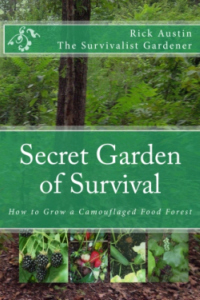
Gardening is my favorite topic to study, so it was not easy to end our conversation, but I knew Rick had goats waiting to be milked. Here is a summary of the gardening tips Rick shared with me from his book, “Secret Garden of Survival – How to Grow a Camouflaged Food Forest.”

Incidentally, Rick has not planted a garden in years, yet he plops 3 to 6 gallons of fresh-picked fruit and vegetables every day onto the kitchen counter for preparing or storing.

Often, Rick’s gathering binges prompt his wife to say, “Stop! I can’t keep up with you,” as she readies the harvest for dehydrating, canning or eating.

How is that possible, you ask? Well, his technique is no longer commonplace, but it once was.

Outside their Appalachian off-grid home in North Carolina, the Austins carved out a completely natural, perpetual garden spot from the mature oak and pine forest. With the help of a hired bulldozer, in one afternoon they cleared a half acre right down to rock and red clay – the kind that turns to brick in hot, dry weather.
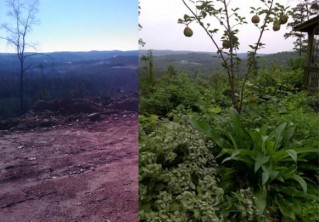
Bare soil producing food one year later

Bare soil producing food one year later

The Austins sold the hardwood, milled the pine for building materials and used the brush and rotted logs to construct berms for hillside terraces. Then, after all available soil was pushed into place, they began planting.

No straight, even, meticulously groomed rows of beans, corn and onions designate the area as a garden plot, however. In fact, whether from a distance or nearly atop the vegetation, it is almost impossible to realize a garden exists there at all. Which is precisely the idea, Rick said.
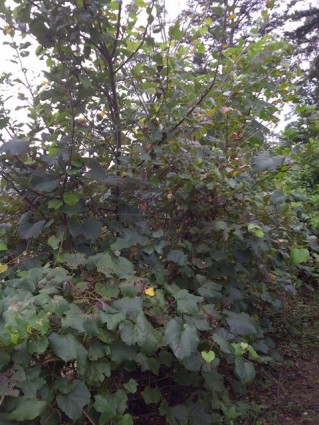
Grapes growing on fruit trees help each other

Grapes growing on fruit trees help each other

Rather than following traditional, modern plans that rely on planting annuals in Army-formation-style rows or boxy raised beds, the Austins instead mimicked nature and thousand-year-old harvesting methods. Before modern agriculture and invention of mechanized farm machinery, most of mankind foraged for food.

“Studies of native indigenous people around the world, people who have lived off the land for generations without electricity, without refrigeration, without commercial agriculture, and without pesticides and insecticides,” Rick said, “showed that these people have lived primarily on perennials as opposed to annuals such as your typical grocery store vegetables.”

In a future world where there is potentially no electricity, refrigeration, supermarkets, seed stores, fertilizers, pesticides and feed stores, it makes sense to look at people who have managed to live successfully for generations without these conveniences, he said.

As hunter/gatherers, people did not spend time planting and tending crops. They didn’t plant in rows. They didn’t plant year after year, didn’t weed, didn’t fertilize and didn’t water plants. Yet humans managed to survive for thousands of years this way.

“Straight rows are a haven for bugs,” Rick said, explaining why his produce grows in concentric circles, or guilds. At the center of each guild is a fruit tree draped in grape vines. Out from there, progressively shorter circles are formed of bushy plants, herbs and groundcover.
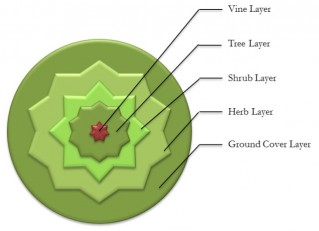
Guild layers -top down view“With perennials, you plant once and harvest for a lifetime,” he said, adding that he spends only about an hour per day in the garden. Now in its fourth season, the garden yields more than the couple can possibly consume. Since they grow most of their own food, this is quite an accomplishment.

Of the few annuals incorporated into the garden, such as tomatoes, all are heirloom, allowing the Austins to save their seeds every year. Insects and weeds also are part of the scheme.

“Ninety percent of bugs are good bugs,” Rick said. “And weeds are ‘pioneer’ plants. They break up the soil.”

Learning to leave weeds in place was one of the greatest challenges for Rick’s wife, who must resist her lifelong inclination to pull every weed. Always, something is in bloom to attract beneficial insects, whether intentionally planted there or not.3rd yr pears
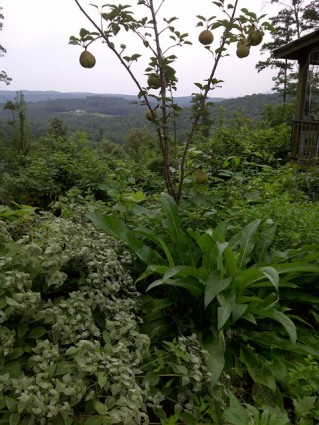
Growing up with an apple orchard in New Hampshire, Rick was a typical apple-grower 30 years ago. The trees grew in geometrically straight rows with nothing between them but grass. Every 10 days and after every rain, Rick religiously sprayed each tree with expensive chemicals to ensure a quality harvest.

“I still had scabby, wormy apples,” Rick told me.

In time, Rick realized he not only was killing bad bugs, but also beneficial predator bugs, disrupting nature’s balance. Now, without any chemicals and by co-mingling plants to deter bad bugs, the Austins’ garden bears much more fruit without all the work or expense. Also, Rick said he is unsure why, but he is no longer afflicted with respiratory problems as he once was.

Rick said his theory about the positive effect of companion- and inter-planting became reality a few years ago when, after filling the garden area, he planted the leftover seed potatoes in a row elsewhere.

“They were doing really well,” Rick said. “They were nice, healthy plants. Then, one morning, I saw the first plant completely decimated, and the one next to it, and the next one.”

By the time Rick got to the fourth plant, the mystery was solved. A swarm of potato beetles was consuming the plants, readily moving from one to the next in the row. The bugs easily found the concentration of plants; and, compounding the problem, good bugs couldn’t compete with the mass of beetles.
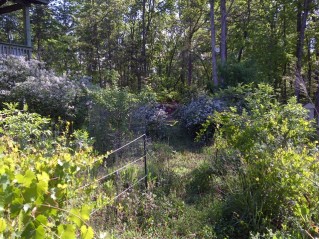
2nd yr pathInter-planting has other benefits. Rick noticed that the grapevines growing on fruit trees instead of trellises yielded more grapes. And, the apple and pear trees produced more fruit shrouded in grapevines. The list does not stop there, though.

“We’re growing just about everything that will grow in this area,” Rick said, indicating peaches, plums, apricots and an assortment of nuts and berries that also fill the garden. He even is experimenting with citrus in a greenhouse built onto the south side of their home. “It’s like permaculture on steroids.”

Larger garden pests, such as rabbits, deer, raccoon and squirrels also are kept at bay with an arsenal of natural repellants. Perhaps the simplest is the dense barrier of blackberry bushes surrounding the garden site.

“Have you ever tried to walk through a patch of blackberries?” Rick asked.

My fascinating conversation with Rick lasted more than an hour. Check back for Part 2, Natural Pest Control, soon. For more on author Rick Austin, visit his facebook page.

Be sure to enter our hand-water-pumping video contest ongoing until July 23 for a chance to win a copy of the Secret Garden of Survival. Rick also is working on another book, the Secret Greenhouse of Survival.

Photos by Rick Austin